Installation
Landscape
2024, Gallery Milchhof Berlin
32 x 180 x 79 cm
wool, pla, 3d print
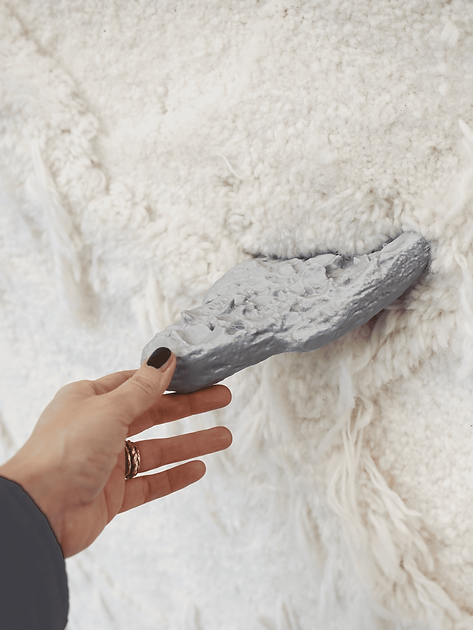
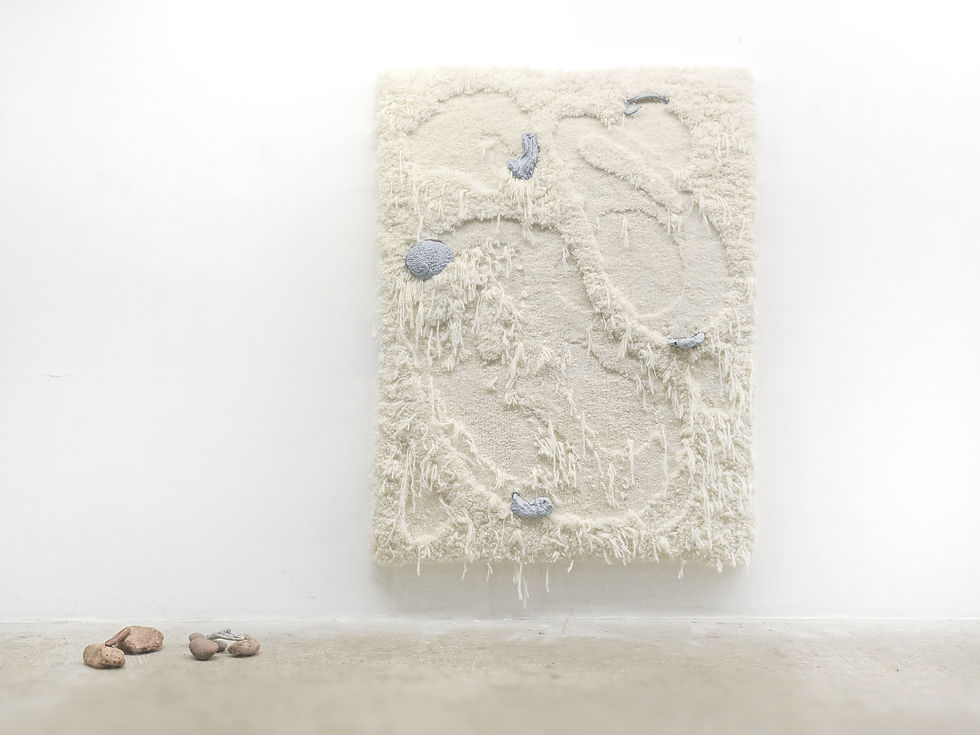

Landscape brings together natural processes of formation, digital production, and craft-based slow practices to investigate time, movement, and material memory. The work begins with the collection of driftwood directly in Sea Ranch, the site where choreographer and pioneer of participatory, site-specific art Anna Halprin realized Build A Driftwood City in 1966. Her practice is central to this work because she understood landscape not as a backdrop, but as an active partner—one in which bodies, materials, and environment collectively generate form.
Over extended periods, the wood was shaped by the movement of water; the sea exposed its growth rings and inscribed time into the material through erosion and layering. These organically developed traces are set in relation to digital processes. The found objects were scanned and 3D printed, technically reconstituting growth rings and stratified lines. In this way, slow, uncontrolled processes encounter machine-programmed rhythms—erosion meets reproduction. The body mediates between these systems: collecting, carrying, scanning, programming, and executing through craft.
The printed forms are embedded in a hand-tufted carpet made of pure wool, introducing another reference to landscape. Wool is not only a tactile, domestic material, but also the product of animals that actively shape landscapes through grazing. Sheep leave traces in vegetation, soil, and paths; their movement is part of a continuous process of environmental formation. In this sense, the carpet functions as a surface that absorbs traces, touch, and use, while simultaneously pointing to ecological cycles and material origins.
As a handcrafted, body-adjacent element, the wool carpet forms a counterpoint to the technical surfaces of the 3D prints. It translates the work into an experiential space of touch, perception, and duration, and reconnects with Halprin’s understanding of body and environment as co-productive systems.
